When I first started as a rooftop artificial turf supplier, I quickly learned that the biggest question I get from property managers, restaurant owners, and residential building developers isn’t about installation timeline or maintenance ease—it’s how much rooftop artificial turf actually costs. I get it. Rooftop projects come with unique constraints: weight limits, weather exposure, accessibility, and local building codes all play a role, and no two rooftops are exactly the same. After talking through hundreds of projects over the past eight years, I’ve broken down the costs clearly to help you plan without the guesswork. Rooftop Artificial Turf

Let’s start with the basics: rooftop artificial turf costs aren’t a one-size-fits-all number. You can’t just pull a square foot price off a shelf because your rooftop’s specific needs will change the final bill. Most suppliers (including mine) structure pricing into three main categories: materials, prep work, and installation. Each of these factors varies a lot based on where your project is and what you’re trying to accomplish.
First, the materials. This is the part that most people start with, and for good reason—artificial turf isn’t just “plastic grass.” Rooftop turf has to handle way more than a backyard lawn: it has to resist strong wind, heavy foot traffic (maybe even furniture or event equipment), extreme temperature swings, and sometimes standing water. The grade of turf you choose makes a huge difference in cost. Entry-level turf, which is usually thinner and made with lower-density fibers, runs between $3 and $5 per square foot. This works for small, low-traffic residential rooftop patios that only get a few uses a week. But here’s the catch: entry-level turf can stretch and fade after a couple of years when exposed to constant rooftop sun, and it might not stand up to accidental spills or frequent cleaning. For most commercial rooftops—restaurant patios, office break areas, or large residential rooftop decks—mid-grade turf is the sweet spot. It’s thicker, has higher fiber density, and is treated to resist UV damage and mildew. That costs between $5 and $8 per square foot. Then there’s premium turf, designed for high-traffic spaces like rooftop bars or event venues. This is the most durable, often made with dual-density fibers that look and feel almost like natural grass, plus extra UV and stain resistance. Premium turf ranges from $8 to $12 per square foot. I always tell clients to match turf grade to their actual use: there’s no point in paying for premium if you’re just covering a small residential patio that’s rarely used.
Next, the foundation and prep work. This is where a lot of first-time rooftop turf buyers underestimate costs, and it’s also where rooftop turf differs from ground-level artificial grass. Rooftops have to be lightweight to avoid putting too much stress on the building’s structure. Ground-level turf uses a base of crushed stone or compacted gravel, but rooftop systems have to be far lighter. Most of the time, we use a lightweight rubber or foam underlayment that’s specifically engineered for rooftops. This underlayment does two key things: it adds a cushion for comfort, and it protects the rooftop membrane from sharp blades or debris. On average, underlayment costs between $1 and $3 per square foot. But prep work goes beyond just underlayment. If your rooftop has old debris, uneven concrete, or areas where the membrane is damaged, you’ll need to fix that before installing turf. Small repairs can add a few hundred dollars, but if you have a large area with extensive unevenness, that can run into thousands. There’s also drainage to consider. Rooftops need to drain water to prevent pooling, so we often add a drainage layer—usually a porous geotextile fabric or lightweight drainage mat—between the underlayment and the turf. If your rooftop has poor drainage, this is a must, and it can add $0.50 to $2 per square foot to the material cost.
Then there’s installation. Rooftop installation is way different than ground-level work. You can’t just pull up a truck and unroll turf—rooftops require special equipment, strict safety protocols, and compliance with local building codes. First, access: if your rooftop is only reachable via a narrow staircase or has tight gates, transporting materials up can add time and labor costs. Most installation companies charge extra for access challenges. Labor rates also vary by location—installing a rooftop in a city like New York or Chicago will cost more than in a smaller suburban town because of higher labor costs. On average, installation for rooftop artificial turf runs between $4 and $7 per square foot. But again, that’s a baseline. If your project has complicated cuts around HVAC units, parapet walls, or skylights, you’ll pay extra for the custom fabrications. Cutting turf around obstacles on the rooftop is labor-intensive, and each obstacle can add time to the job. I had a client last year with a rooftop bar that had 12 HVAC units scattered across the space; the cuts alone added two days of labor, which bumped their installation cost up by almost $1,500.
Now, let’s put that all together for a real-world example to make it concrete. Let’s say you have a 500-square-foot residential rooftop patio that’s in good shape, with no major repairs needed, and it’s only used occasionally for small gatherings. You’d probably go with mid-grade turf, a basic lightweight underlayment, and no extra drainage. Here’s how that breaks down: turf at $6 per sq ft = $3,000, underlayment at $2 per sq ft = $1,000, installation at $5 per sq ft = $2,500. Total would be around $6,500, or $13 per square foot. That’s a realistic number for a small residential project.
Now let’s take a commercial example, like a 1,500-square-foot rooftop restaurant patio that gets heavy traffic, has a few HVAC units, and is in a city with higher labor costs. You’d go with mid-to-premium turf, maybe a thicker underlayment for comfort during long shifts, and drainage to handle foot traffic and occasional spillage. Let’s say turf is $7 per sq ft, underlayment is $2.50, drainage is $1, installation is $6, plus $2,000 extra for cuts around obstacles. That breaks down to: turf = $10,500, underlayment = $3,750, drainage = $1,500, installation = $9,000, plus $2,000 for custom cuts = total of $26,750, or about $17.80 per square foot. That’s in line with what I quote for similar commercial projects.
I always make sure to mention long-term costs too, because that’s a big part of the value. Some cheaper turf might seem like a deal upfront, but it will fade in two years and need replacing, which costs even more. Mid-grade turf, when properly installed, can last 10 to 15 years, and premium turf can last up to 20 years. Maintenance is another factor: rooftop turf is way lower maintenance than natural grass—no mowing, no watering, no fertilizing. You just rinse it occasionally and pick up debris. The only regular cost is a deep clean once or twice a year, which runs between $0.25 and $0.50 per square foot, way cheaper than the monthly cost of maintaining a natural rooftop lawn.
There are also a few hidden costs that people often overlook when budgeting. First, building code and permit fees. Most cities require a permit for rooftop installations, and that can range from $100 for small residential projects to $1,000 or more for commercial ones. Some cities also require a structural assessment to make sure your building can support the weight of the turf and underlayment. That assessment usually costs $500 to $1,500, depending on the size of the rooftop. Another hidden cost: waste disposal. When you remove old roofing material or old natural grass to prepare the rooftop, you have to dispose of that properly, and that can add a few hundred dollars to your total. Also, if you plan to add accessories like outdoor furniture, planters, or lighting to your turf, make sure those are rated for rooftop use—cheap outdoor furniture might rust or damage the turf, so investing in high-quality, lightweight accessories can save you money down the line.
A common question I get is whether it’s cheaper to do the installation yourself. I never recommend that. Rooftop installation requires safety harnesses, specialized tools, and knowledge of how to cut turf properly to avoid gaps or loose edges. If turf isn’t installed correctly, it can shift or lift in strong winds, which is a safety hazard and will void most product warranties. I once had a client who tried to install their rooftop turf themselves; within a year, a large section of turf lifted in a windstorm, ripped loose, and almost hit a pedestrian on the sidewalk below. They had to pay twice to fix it—once to remove the loose turf and once to hire a professional to install it correctly. That ended up costing them more than if they’d hired a professional in the first place.
Another factor that can change costs is your location. Rooftops in coastal areas, for example, have to handle salt air, which is harder on turf fibers. So clients in Miami or Los Angeles might need a salt-resistant turf grade that costs a bit more, but it will last longer. Clients in cold climates have to handle freeze-thaw cycles, which means the underlayment has to be flexible enough to expand and contract without cracking. All of these regional factors play into the final price, which is why I always work with clients to tailor a quote to their specific location and needs.
At the end of the day, the right cost for your rooftop artificial turf isn’t just about the upfront number—it’s about getting a system that fits your usage, lasts a long time, and is safe. I’ve seen clients cut corners on cheap turf only to replace it two years later, which ends up costing them more. I’ve also had clients who splurge on premium turf for a small patio that doesn’t need it, wasting money on features they’ll never use. That’s why I always start every conversation with a free assessment: I look at the rooftop, talk about how they’ll use the space, and give a custom quote that breaks down every cost so there are no surprises.
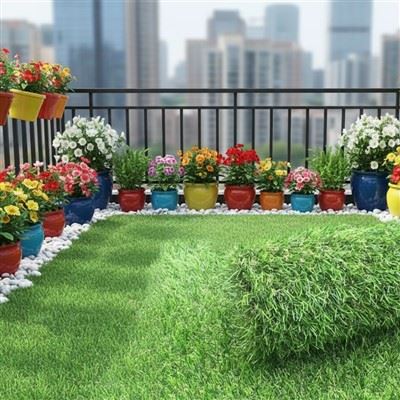
If you’re ready to plan your rooftop artificial turf project, don’t go it alone. Reach out to us to discuss your specific needs, get a detailed quote, and ask any questions you have. Whether you’re a residential property owner looking for a small patio or a restaurant planning a large rooftop venue, we have the experience and products to get the job done right.
Artificial Turf for Balcony References
- Synthetic Turf Council. (2022). Rooftop Artificial Turf: Installation Guidelines and Cost Considerations.
- National Roofing Contractors Association. (2021). Lightweight Roof Coverings for Urban Spaces.
- International Code Council. (2020). Building Code Requirements for Rooftop Amenity Spaces.
- Green Roof Industry Association. (2023). Comparative Cost Analysis of Rooftop Turf vs. Natural Lawns.
Yiwu Duofu Artificial Flower Co., Ltd.
As one of the most professional rooftop artificial turf manufacturers and suppliers in China, our products have good reputation in the market. Please feel free to wholesale bulk custom made rooftop artificial turf from our factory. Good service and quality products are available.
Address: Building B, No. 566 Chunhua Road
E-mail: 13373813738@aliyun.com
WebSite: https://www.chinaturffactory.com/
