Hey everyone! If you’ve ever shopped for vintage bronze animal statues—like a regal 19th-century lion, a delicate 1920s deer, or even a mid-century modern bulldog—you know the drill: spotting a fake is way harder than it looks. As someone who’s been in the bronze animal statue supply game for over 10 years, I’ve lost count of how many times a seller has sworn their “antique bronze” was from the 1800s… only to find out it’s a 2007 knockoff from a small foundry in China. Today I’m pulling back the curtain on how we (at my bronze statue shop) actually date these pieces—no fancy lab degree required, just real, hands-on tricks I’ve picked up over the years. Let’s dive in. Bronze Animal Statue
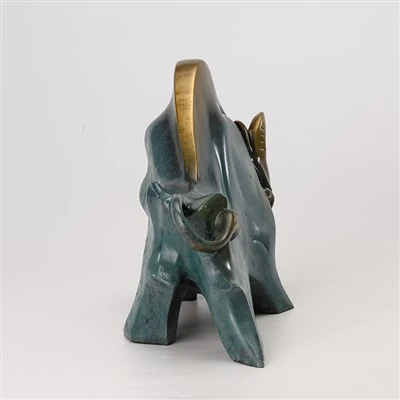
First off, let’s get one thing straight: dating bronze isn’t just guessing based on how “old” it looks. A lot of new bronzes are intentionally aged to look like they’ve sat in a barn for 100 years, so you have to dig past that first. The first thing I always check is the patina—not just the color, but how it’s layered. Patina is that thin, colorful crust that forms on bronze over decades (or centuries) from exposure to air, moisture, and even chemicals. Real old patina isn’t just a top coat. It seeps into the tiny crevices of the statue, like under a lion’s mane curls or between a deer’s antler tines. If you run a clean, dry cloth over the statue, a real patina won’t rub off. Fake patina, though? Usually it’s just a paint or wax coating. I once had a guy bring in a “1890s bronze cat” that had a perfect dark green patina… until I wiped a paper towel along its paw, and it came away bright green. Turned out he’d bought it at a flea market for $20, and the patina was spray-on.
Now, what should real patina feel like? It’s not just smooth—older patina often has a slightly uneven, weathered texture, like it’s been touched by time. If you see a brand-new statue with a perfectly uniform green or brown patina, that’s a red flag. Modern foundries use industrial patina chemicals that give a super consistent look, while old pieces reacted naturally with the elements. For example, 19th-century European bronzes often had a warm, brownish-red patina (called “brown bronze”) from being stored in dry European attics, while American bronzes from the same era were more likely to have that deep, forest-green patina from hanging in barns or outside porches. Mid-century modern bronzes (think 1950s-1970s) usually have a lighter, more muted patina—they were often made for indoor decor, so less exposure to harsh weather.
Next big one: the casting marks and foundry signatures. This is my go-to, because foundries almost always marked their work, and those marks can tell you exactly when a statue was made. Let’s break this down. First, look at how the signature is applied. Old bronzes (pre-1950s, mostly) were cast using the lost-wax method, which means the signature was pressed into the wax before pouring the bronze. So the signature is indented into the bronze, not stamped on top. If you see a signature that looks like it’s been stamped on—like sharp, raised letters—there’s a 90% chance it’s a post-1980 fake. Modern foundries use stamping to save time, so that’s a dead giveaway.
Then there’s the date and foundry mark itself. Let’s say you have a statue signed “Barbedienne”—that’s a famous 19th-century French foundry. Barbedienne only operated from 1838 to 1900, so any statue signed with their mark can’t be younger than 120+ years. But wait—some fakes will copy old foundry marks, so you have to cross-check. For example, I once saw a “1870s Barbedienne horse” that had the signature stamped on (which is wrong, since Barbedienne used indented signatures) and a foundry mark that Barbedienne never actually used. Another thing: some mid-century foundries, like American foundry Gorham, used date codes in their marks. Gorham started using a three-letter date code in the 1940s, so if a statue has that code, you can look it up to pin down the exact year. Pro tip: don’t trust just one mark. If a statue has both a signature and a foundry mark, make sure both line up with the dates that foundry was in business.
Now, let’s talk about the actual bronze composition. This is where I’ll admit we sometimes use a small tool (it’s called a surface Raman spectrometer, but don’t freak out—it’s not nuclear science) to test the metal, but if you don’t have that, there are tricks. Old bronzes are usually higher in copper and tin, with very little zinc. Zinc bronze became super popular in the early 20th century, so if a statue is mostly zinc, it’s probably not pre-1900. How to tell? Tap it! Old bronze has a deep, resonant “clang” when you tap it with your knuckle. New zinc bronzes sound more like a dull “thud.” That’s a trick I learned from my dad, who’s been dealing in bronzes since the 70s—he’d tap every single statue we got in, and if it sounded off, we’d hold it back for closer testing.
Wait, another thing on composition: lead. Old bronzes sometimes had a little lead added to make casting easier, but after the 1970s, a lot of places stopped using lead because of regulations. So if a statue has a high lead content, it’s more likely pre-1970, but again—fakes can add lead too, so don’t rely on that alone. It’s just another puzzle piece.
Let’s move to style. Animal statues change a lot over time, so that’s a big clue. 18th and 19th-century European animal statues (think lions, deer, dogs) are super detailed—they’re almost like miniature sculptures. A 1850s bronze greyhound will have every muscle definition, every strand of fur, even the little veins in its ears. That’s because back then, bronzes were for wealthy collectors, so every detail mattered. Then, in the Art Deco era (1920s-1940s), animal statues got way more streamlined, geometric. A 1930s bronze panther would have sharp, angular lines, not all those tiny details. Mid-century modern (1950s-1960s) took that even further—think abstract, stylized animals, not realistic at all. Modern statues, from the 1980s to now, can be any style, but a lot of them are mass-produced, so the details are often sloppy. A 2000s bronze bear might have blurry paw pads, or fur that looks like it’s been hastily carved, while an 1890s bear has tiny, individual claw marks.
Of course, style isn’t perfect—some modern artists make really detailed, vintage-style statues—but if a statue has a style that doesn’t match its supposed age, that’s a red flag. For example, if someone says it’s a 1920s Art Deco lion, but it has super realistic, 18th-century detail, that’s probably fake. I once got a call from a lady who had a “1920s deer statue” that looked like it was from the 1700s—she’d paid $5,000 for it at an auction, and when we checked, the style was way off, and the patina rubbed off. She ended up selling it back to the auction for half what she paid, because she couldn’t prove it was fake. That’s why style matters so much—if it doesn’t “feel” like it fits, it’s probably not.
Now, what about repairs? Old statues get damaged, right? So if you see a repair, that can actually help date it—if you know what kind of repairs were common when. Pre-1950s, repairs were usually done with bronze solder, which is a mix of tin and lead. After the 1950s, they started using silver solder, which is brighter and harder to spot. If a statue has a repair that looks like it was done with silver solder, it’s probably post-1950. Also, old statues often have cracks from being dropped or stored, and those cracks would have been filled with a material that matches the patina. Modern cracks are usually just filled with a plastic or resin, which is easy to spot because it looks too smooth, not like it’s part of the bronze.
Wait, here’s a mistake I see a lot: people think old statues have scratches or wear all over. Not exactly. The wear is usually in places that would get touched a lot—like the paws of a statue that was on a desk, or the nose of a dog statue that was held a lot. It’s not uniform. A fake “old” statue might have scratches all over the back, or on the belly, which don’t make any sense because no one would touch those places. Real wear is only on high-contact areas. I once bought a “18th-century bronze horse” that had scratches all over its tail and belly—turns out it was made in 2018, and the faker had dragged it across a concrete floor to make it look worn. Oops.
Let’s also talk about documentation. Any real antique bronze should have some kind of paper trail—receipts from when it was sold, old photos of it in a home, a certificate from a museum or auction. If a seller says it’s from the 1800s but can’t show you any paperwork, that’s a huge red flag. A lot of fakes don’t come with documentation, because there’s none to forge. I had a client a few years back who bought a “1790s bronze eagle” from a guy at a flea market for $10,000, and when he asked for documentation, the seller said it was “lost in a move.” We ended up testing it, and it was 10 years old. The lesson here: always ask for paperwork. If it’s a real old piece, there should be a paper trail somewhere.
Wait, let’s wrap this up with a quick checklist, so you can follow along next time you’re looking at a bronze animal statue:
- Check the patina: Does it seep into crevices? Does it not rub off? Uniform patina = fake.
- Look at the marks: Are they indented (old) or stamped (new)? Cross-check foundry marks to make sure they existed when the statue was supposed to be made.
- Tap it: Deep clang = old bronze; dull thud = new zinc.
- Match the style: Does the animal’s look fit the era it’s supposed to be from?
- Check for wear: Is it only on high-contact areas, or all over?
- Ask for documentation: If there’s none, be extra skeptical.
At the end of the day, dating bronze animal statues is about putting all these pieces together—no single trick works on its own. We’ve had fakes that passed the patina test but failed the mark test, and vice versa. That’s why, at my shop, we never buy a statue without at least two people checking it over, and sometimes we send it for lab testing if we’re unsure.
Now, if you’re in the market for a bronze animal statue—whether it’s a vintage piece for your collection, or a custom piece for your home or business—don’t guess. We’ve got a huge selection of authentic vintage bronzes from the 19th and 20th centuries, plus high-quality modern reproductions if that’s what you’re after. Every piece we sell comes with a certificate of authenticity, and our team can walk you through exactly how we dated it, so you know you’re getting what you pay for. Whether you’re a collector looking for a rare antique lion, a café owner wanting a custom dog statue for your entrance, or just someone who loves animal statues, hit us up to chat about what you’re looking for. We’re here to help, and we’ll never sell you a fake.
Bronze Relief Mural References:
- Scott, D. A. (2002). Bronze and Bronze Alloys in Ancient Civilizations. Archetype Publications.
- LaNiece, S., & Craddock, P. T. (1993). Metal plating and patination: cultural, technical and analytical developments. Routledge.
- Myers, B. S. (2015). The Art of Bronze Casting: From Foundry to Finish. Lark Books.
- American Society for Testing and Materials. (2018). Standard Guide for Examination of Archaeological and Historic Metal Objects. ASTM International.
Huizhou Hexin Intelligent Manufacturing Industrial Co., Ltd.
Huizhou Hexin Intelligent Manufacturing Industrial Co., Ltd. is one of the most professional bronze animal statue manufacturers and suppliers in China. Please feel free to buy the newest bronze animal statue made in China here and get pricelist from our factory. All customized products are with high quality and competitive price.
Address: No. 31, Second Industrial Zone, Nankeng Village, Xinxu Town, Huiyang District, Huizhou City, Guangdong Province, P.R.China
E-mail: hztbjr@126.com
WebSite: https://www.bronzehexin.com/
